
National Museum of Qatar: Tickets, Timings and What to See (2026)
A practical 2026 guide to the National Museum of Qatar in Doha, covering opening hours, ticket prices and free entry rules, the Gold Line metro, the three gallery chapters, the Pearl Carpet of Baroda, dining, the park and family tips.
Quick Answer
The National Museum of Qatar is open every day except Tuesday: 9am to 7pm on Saturday, Sunday, Monday and Wednesday, 9am to 9pm on Thursday and 1:30pm to 7pm on Friday, with last entry 45 minutes before closing. Entry is free for Qatar residents with a valid QID and for children under 16, while non-resident adults pay QAR 50 under Qatar Museums' published pricing and non-resident students get 50% off. The museum is on Museum Park Street at the southern end of the Corniche, next to National Museum station on the Doha Metro Gold Line. Allow two to three hours for the galleries.
Visit Official ServiceOn this page
- National Museum of Qatar at a Glance
- National Museum of Qatar Opening Hours
- Ticket Prices and Who Gets in Free
- How to Get to the National Museum of Qatar
- The Architecture: Jean Nouvel's Desert Rose
- Inside the Galleries: Three Chapters of Qatar's Story
- Highlights You Should Not Miss
- How Long to Spend at the National Museum
- Restaurant, Cafés and Gift Shop
- The Park at NMoQ
- Tips for Families
- Dress Code, Photography and Museum Rules
- Accessibility
- Best Time to Visit
- Combining the Museum with MIA, Souq Waqif and the Corniche
- Final Thoughts
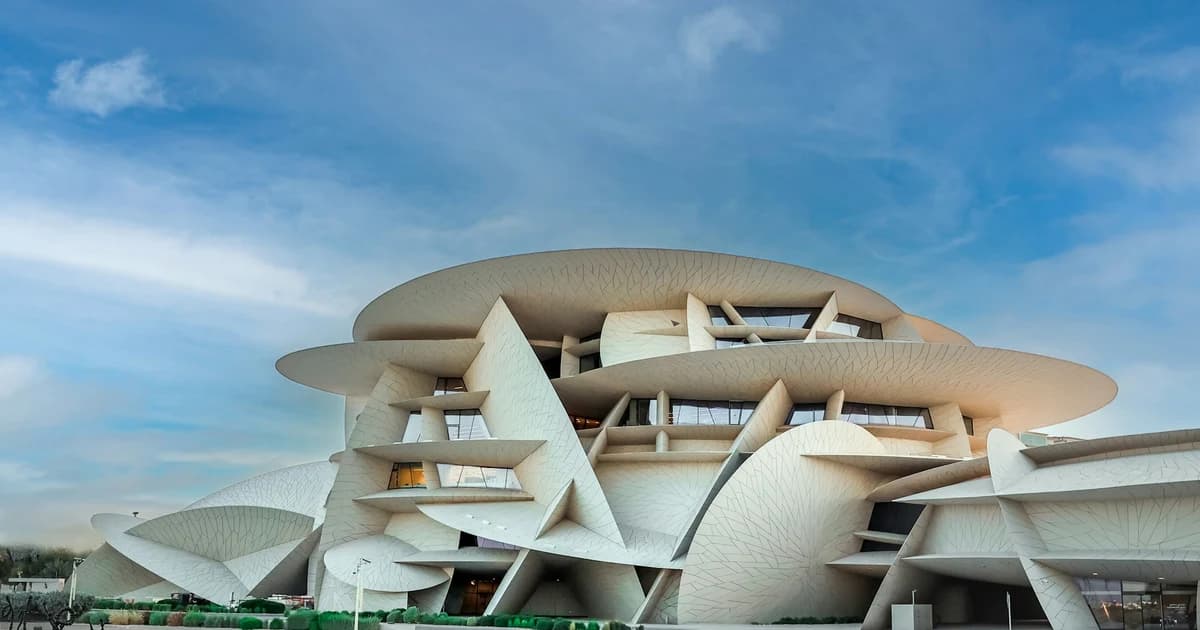
The National Museum of Qatar is the one building in Doha that explains everything else you see in the country. Its galleries take you from the rocks the peninsula is made of, through Bedouin camps and pearling boats, to the oil and gas economy that built the skyline across the bay. The building itself, Jean Nouvel's cluster of tilted discs modelled on a desert rose crystal, is worth the trip even if you never go inside.
This guide covers opening hours (including the short Friday session), ticket prices for residents and tourists, how to get there, what is in each gallery, where to eat, and how to combine the visit with the Museum of Islamic Art and Souq Waqif. Details were checked against the museum's official pages in October 2026.
National Museum of Qatar at a Glance
| Detail | What to know |
|---|---|
| Address | Museum Park Street, at the southern end of the Doha Corniche |
| Nearest metro | National Museum station, Gold Line |
| Opening days | Every day except Tuesday |
| Usual hours | 9am to 7pm (Thursday to 9pm, Friday 1:30pm to 7pm) |
| Residents with a QID | Free |
| Non-resident adults | QAR 50 (confirm on the booking page) |
| Children under 16 | Free |
| Time needed | 2 to 3 hours for the galleries |
| Phone | +974 4452 5555 |
National Museum of Qatar Opening Hours
The two things that catch people out are the Tuesday closure and the late start on Friday, when the doors do not open until after midday prayers.
| Day | Opening hours |
|---|---|
| Saturday | 9am to 7pm |
| Sunday | 9am to 7pm |
| Monday | 9am to 7pm |
| Tuesday | Closed |
| Wednesday | 9am to 7pm |
| Thursday | 9am to 9pm |
| Friday | 1:30pm to 7pm |
- Last entry is 45 minutes before closing, when staff also start clearing the galleries.
- Thursday is the late night, which suits residents coming after work.
- Ramadan and Eid hours are announced separately each year, so check the official site in those periods.
- The museum currently notes that some galleries may be closed for enhancement work, so a room or two on the route could be shut.
Ticket Prices and Who Gets in Free
Qatar Museums uses one pricing structure for its big paid venues, including this museum and the Museum of Islamic Art. If you hold a valid Qatar ID, you do not pay.
| Visitor type | Price | Notes |
|---|---|---|
| Qatari citizens and residents | Free | Show a valid QID. Covers permanent galleries and temporary exhibitions. |
| Children under 16 | Free | Residents and tourists alike. |
| Non-resident adults | QAR 50 | Set in Qatar Museums' 2023 pricing update. Some 2026 resale listings show lower prices, so check the live rate when booking. |
| Non-resident students | 50% discount | Bring a valid student card. |
| Groups of 25 or more | 50% discount | Email the museum in advance to reserve a block. |
| Gift shop, cafés and restaurant only | Free | No gallery ticket needed. |
ICOM members and organised school and university tours also enter free. A ticket covers the permanent collection and any temporary exhibitions, is valid for one entry on the date shown, and cannot be refunded. You can buy at the desk or reserve a time slot online, which is worth doing on busy winter weekends.
Visitors flying in should sort out entry paperwork first; our guide on applying for a Hayya visa explains who needs one. Relatives visiting residents do not hold a QID, so adults among them pay the non-resident rate.
What happened to the Culture Pass?
Culture Pass is Qatar Museums' membership scheme, which offered talks, tours, workshops and café and shop discounts. Qatar Museums' Culture Pass pages now say it is closed to new members, with existing members keeping their benefits until a new programme launches. Residents lose little, since entry is already free with a QID; long-stay visitors can ask at the ticket desk whether a replacement is available.
How to Get to the National Museum of Qatar
By Doha Metro
National Museum station is on the Gold Line, a short walk from the museum entrance. The Gold Line also serves Souq Waqif and Msheireb, so from the airport, West Bay or Lusail on the Red Line, change at Msheireb. Our Doha Metro map guide covers fares and the daily cap.
By car, taxi or on foot
Drivers enter from the roundabout at Mathaf Street and Museum Park Street, which leads to on-site parking. A Karwa taxi or Uber from Hamad International Airport takes about 15 minutes in normal traffic. The North Playground and park kiosks have their own pedestrian gate on Emrair Street. From October to April you can walk the Corniche from the Museum of Islamic Art in 15 to 20 minutes; in summer, the walk has too little shade.
The Architecture: Jean Nouvel's Desert Rose
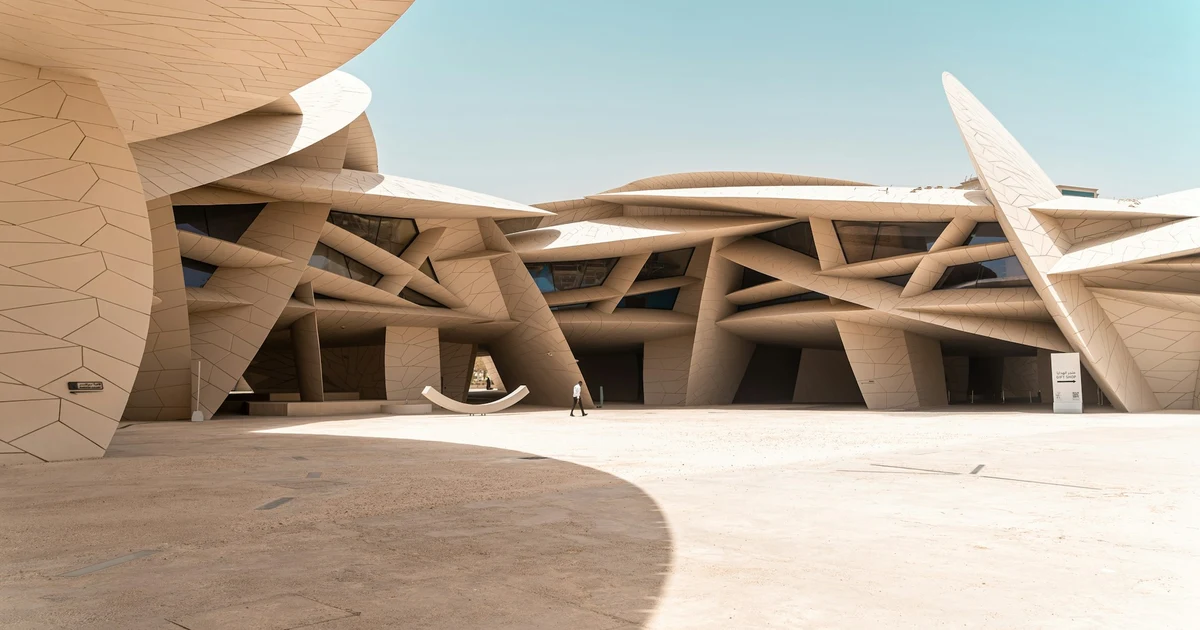
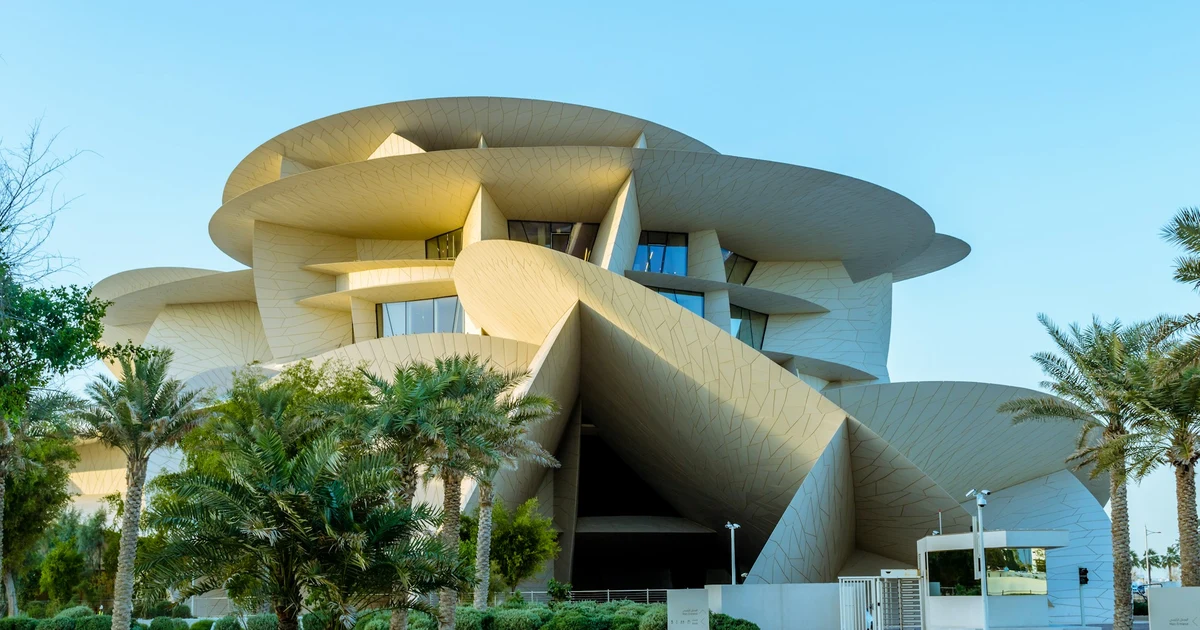
The current building opened on 28 March 2019. Jean Nouvel based it on the desert rose, the rosette of crystals that forms under Gulf salt flats when wind, sand and salty groundwater combine. The museum is a pile of interlocking discs of different sizes that act as walls, floors and roofs at once, and their deep overhangs shade the terraces below.
The discs wrap around the palace of Sheikh Abdullah bin Jassim Al Thani, his family home and the seat of government for 25 years. The palace became Qatar's first national museum in 1975 and now stands restored in the middle of the complex.
In the lagoon out front stand 114 black sculptures: ALFA by Jean-Michel Othoniel. They double as fountains, firing arcs of water at intervals during the day, and are lit after dark, which makes an evening walk past worthwhile even when the museum is closed.
Inside the Galleries: Three Chapters of Qatar's Story
The permanent galleries run as one continuous route of about 11 spaces in three chapters. Many rooms have large films by international directors projected across the curved walls, and some add sound and smell, such as coffee in the desert gallery.
Chapter One: Beginnings
The story starts more than 700 million years ago with the geology that formed the peninsula, including a model of Qataraspis deprofundis, an armoured fish known from a fossil found nearly 4 kilometres underground. Next come Qatar's natural environments, with a life-size whale shark hanging from the ceiling, and archaeology, with around 1,000 artefacts and reconstructed rock carvings from Al Jassassiya.
Chapter Two: Life in Qatar
The chapter most visitors remember follows families moving between the inland desert, al barr, and the coast, partly through large oral history screens of Qatari elders. The desert gallery has a full Bedouin tent, falconry gear, coffee tools and sadu weaving. A staircase leads down to Life on the Coast, built around a model of Al Zubarah, Qatar's first UNESCO World Heritage Site, then Nafas, Mira Nair's film on pearl diving, and finally Pearls and Celebrations.
Chapter Three: Modern History
The last chapter covers contact with the Portuguese, Ottomans and British and the unification of the tribes under Sheikh Jassim bin Mohammed bin Thani. It then moves through the collapse of the pearl trade, the discovery of oil, the rise of liquefied natural gas and a large model of Doha's growth, ending with Qatar under the current Emir, including the 2017 blockade.
Highlights You Should Not Miss
- The Pearl Carpet of Baroda: commissioned in 1865 by Khande Rao Gaekwad, the Maharaja of Baroda, as a covering for the tomb of the Prophet Mohammed (PBUH) in Medina. It is embroidered with Gulf seed pearls, often counted at around 1.5 million, plus precious stones, and is the centrepiece of the Pearls and Celebrations gallery.
- The Palace of Sheikh Abdullah bin Jassim Al Thani: the restored palace at the heart of the site, with its own seven-stop audio tour. Walk its courtyard rather than treating it as a corridor.
- The Al Zubarah model and the Al Zubarah Quran: good preparation if you plan a day trip to the real fort in the north.
Free audio guides in several languages, including a 24-stop Highlights tour, play on your own phone, so bring headphones. Guided tours in English and Arabic are listed on the museum's What's On page.
How Long to Spend at the National Museum
Plan on two to three hours for the galleries. The route is long and the films are worth sitting through, so an hour feels rushed. Add lunch and time in the park with children and it becomes a comfortable half day. Wear comfortable shoes, as the route includes ramps and stairs.
Restaurant, Cafés and Gift Shop
| Venue | What it is | Hours |
|---|---|---|
| Jiwan | Restaurant serving modern dishes inspired by Qatar, the Levant, North Africa and South Asia, served family-style, with a terrace over the palace and the sea | Sat, Sun, Mon, Wed, Thu 12:30pm to 9pm; Fri 1:30pm to 9pm; closed Tuesday |
| Desert Rose Café | Ground floor café run by Qatari chef Noof Al Marri, a MICHELIN Selected restaurant focused on Qatari flavours | Saturday to Thursday 8am to 6pm; Friday 1:30pm to 9pm |
| Thalatheen Café | Outdoor vegan café just outside the entrance | Saturday to Thursday 9am to 7pm; Friday 1pm to 9pm |
Jiwan, named after the Qatari word for a perfect pearl, is the smartest meal in this part of town, so book for dinner and weekend lunches. Desert Rose Café suits a Qatari breakfast or karak before the galleries. None of these needs a gallery ticket.
The NMoQ Gift Shop, designed by Koichi Takada to evoke the Dahl Al Misfir cave, is one of Doha's better places for gifts that are actually from Qatar, and there is a separate Children's Gift Shop with books and puzzles. Both follow museum hours. A library sits on the third floor.
The Park at NMoQ
The park is one of the better family spaces on the Corniche. The Heritage Garden is planted with labelled native Qatari species. Children head for the Cave of Wonders, modelled on a dahl (a desert sinkhole cave) with glowing rocks and a giant gecko on the wall, and the Nakilat Adventure Ship, built to look like the wreck of a traditional Qatari boat. The Qatar TotalEnergies Playground closes during summer.
Tips for Families
- Look for the Family Exhibits inside the galleries: children can try excavation, pretend to milk a goat and make Arabic coffee, and row a dhow or hunt for pearls.
- Children under 12 must stay with an adult at all times.
- Changing tables are in the ladies' restrooms, and there are restrooms inside the galleries as well as by the cloakroom and cafés.
- Prayer rooms are by the gift shop and in the park kiosks, and free Wi-Fi covers the museum.
- With young children, split the visit between galleries and playgrounds. The whale shark and the desert tent hold their attention best.
Dress Code, Photography and Museum Rules
- Dress modestly: cover shoulders and knees. A limited number of abayas and shaylas can be borrowed, and staff can refuse entry for unsuitable clothing.
- Security: everyone is screened. Small bags are fine; large bags go in the cloakroom.
- Photography: allowed for personal, non-commercial use in available light unless signs say otherwise. No flash, tripods or selfie sticks. Commercial filming needs a request two weeks ahead.
- In the galleries: no food or drink, no touching objects, and no coloured pencils, ink pens or markers.
Accessibility
Wheelchair-accessible golf carts run from the car park to the entrance, wheelchairs can be borrowed at reception, and lifts serve the whole building. The museum notes cobblestones outside and uneven floors in the Archaeology of Qatar and Life on the Coast galleries.
Blind and partially sighted visitors can book tailored tours and use multisensory stations with braille and tactile models. Sign language tours in Arabic and English can be arranged with the Qatar Social and Cultural Center for the Deaf. A sensory room sits on the ground floor behind the cloakroom (ask at the front desk), and a magnifier and hearing loop unit are available on request.
Best Time to Visit
Weekday mornings right after the 9am opening are quietest; school groups build through late morning and winter weekends are busiest. Thursday evening works well for residents, with dinner at Jiwan afterwards. Because the galleries are indoors, the museum is one of the best things to do in Doha in summer. Our Qatar weather guide shows which months suit the park and the Corniche walk.
Combining the Museum with MIA, Souq Waqif and the Corniche
The museum sits at one end of Doha's most walkable cultural strip. A half-day plan for October to April:
- 9am: arrive at opening and do the galleries before the groups.
- Midday: lunch at Jiwan or Desert Rose Café, then look at the ALFA fountains.
- Early afternoon: walk the Corniche or take a short taxi to the Museum of Islamic Art and MIA Park, checking MIA's own hours first.
- Late afternoon: head to Souq Waqif, on foot from MIA or one stop on the Gold Line.
Souq Waqif is at its best after sunset, so it makes an easy dinner stop once the museum closes. The Falcon Souq and the souq's restaurants are a short taxi ride away.
If the galleries leave you wanting to see the real sites, Al Zubarah and Qatar's other heritage forts are a day trip north. They sit alongside the city sights in the best places to visit in Qatar.
Final Thoughts
For residents, the National Museum of Qatar is one of Doha's best free days out: show your QID, give it three unhurried hours, and you will understand the country far better. For tourists, QAR 50 for the building, the films and the Pearl Carpet of Baroda is good value.
Avoid Tuesdays, remember the late Friday start, dress modestly and leave time for the palace at the end of the route. Add the Museum of Islamic Art and an evening at Souq Waqif and you have covered the heart of Doha in one day.
Official Sources
- National Museum of Qatar: Plan Your Visit (opens official source in a new tab)Official opening hours, getting here, dining, gift shop and the link to book tickets.
- NMoQ Visitor Guidelines (opens official source in a new tab)Official rules on tickets, dress code, bags, photography, children and on-site amenities.
- NMoQ Galleries (opens official source in a new tab)The museum's own description of the three chapters, each gallery, its films and the Old Palace.
- NMoQ Accessibility (opens official source in a new tab)Wheelchair access, sensory room, sign language tours and assistive technology.
- Visit Qatar: National Museum of Qatar (opens official source in a new tab)Qatar Tourism's page with location, transport and the museum's highlight objects.
- Qatar Museums: ALFA by Jean-Michel Othoniel (opens official source in a new tab)Official page for the 114 fountain sculptures in the museum lagoon.
- Qatar Rail (Doha Metro) (opens official source in a new tab)Official Doha Metro network, Gold Line stations and fares.
Frequently Asked Questions
Is the National Museum of Qatar free for residents?
Yes. Qatari citizens and residents enter free on presentation of a valid QID, and that covers the permanent galleries and temporary exhibitions. Children under 16 also enter free whether or not they live in Qatar.
How much is the National Museum of Qatar ticket for tourists?
Under Qatar Museums' published pricing, non-resident adults pay QAR 50, and non-resident students and groups of 25 or more get a 50% discount. Prices can change, so confirm the current rate on the official booking page before you go.
What are the National Museum of Qatar timings on Friday?
On Friday the museum opens later, from 1:30pm to 7pm. On Saturday, Sunday, Monday and Wednesday it is open 9am to 7pm, on Thursday 9am to 9pm, and it is closed every Tuesday. Last entry is 45 minutes before closing.
Which metro station is closest to the National Museum of Qatar?
National Museum station on the Doha Metro Gold Line, a short walk from the museum entrance. From the Red Line or Green Line, change to the Gold Line at Msheireb.
How long does it take to see the National Museum of Qatar?
Most people need two to three hours for the galleries. Add lunch at Jiwan or Desert Rose Café and time in the park and playgrounds, and it becomes a comfortable half day.
Can you take photos inside the National Museum of Qatar?
Yes, for personal, non-commercial use in available light, unless a sign says otherwise. Flash, tripods and selfie sticks are not allowed, and commercial filming needs a request submitted at least two weeks in advance.
What is the dress code at the National Museum of Qatar?
Dress modestly with shoulders and knees covered. The museum has a limited number of abayas and shaylas to borrow, and staff can refuse entry if clothing is considered unsuitable.
Written by
Sheikh Baber AliI’m Sheikh Baber Ali, a writer and editor at QatarVia. I’m naturally curious about how things work and enjoy digging into the details behind the questions people have about living, working, and getting around in Qatar. My approach is simple: research carefully, check the details, and explain things the way I’d want someone to explain them to me. I’m always looking for useful stories, changing information, and practical details worth sharing with our readers.
View all guides by Sheikh Baber Ali →Related guides
Katara Cultural Village Doha: Things to Do, Timings and Beach (2026)
A practical guide to Katara Cultural Village in Doha: how to get there on the Red Line, what is free, Katara Beach fees and rules, the amphi

Desert Safari Qatar: Inland Sea Tours, Prices and What to Expect
A practical guide to a desert safari in Qatar: how Inland Sea tours from Doha work, what they include, published price ranges, how to choose
Lusail Boulevard Qatar: How to Get There, Things to Do and Events (2026)
A practical guide to Lusail Boulevard in Qatar: how to get there by metro, tram or car, when to go, what to see, the big annual celebrations